

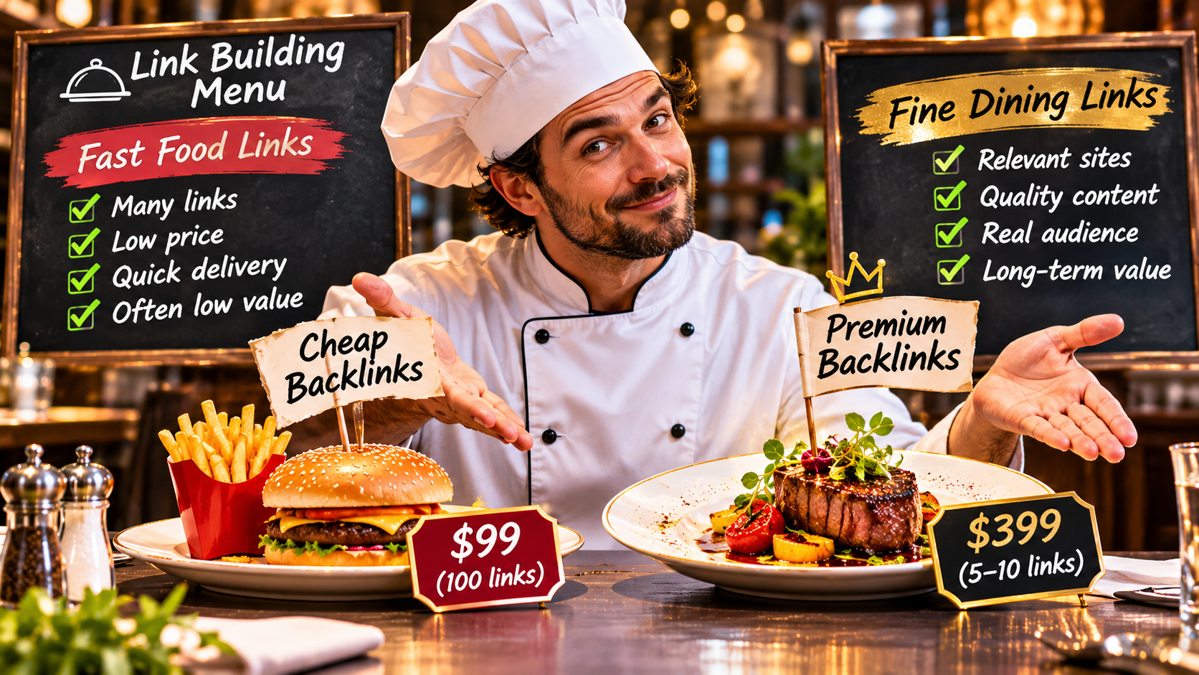
Link building prices can be as confusing as walking into a restaurant where one burger costs $5 and another dish costs $200. Both satisfy your hunger, but are you really paying for the same experience?
That's exactly what marketing consultant James Parker wondered when he entered a rather unusual restaurant called The Backlink Bistro.
Instead of serving ordinary food, this restaurant specialized in SEO publications.
Its menu offered everything from bargain backlink bundles to premium editorial placements.
James had a $500 marketing budget and one simple objective: find worthwhile publication opportunities for his client's online furniture store.
What happened next taught him more about backlink economics than any conventional SEO pricing guide.
Welcome to The Backlink Bistro
“Good evening, sir! Welcome to The Backlink Bistro,” announced a cheerful waiter wearing a white shirt and a tie decorated with tiny chain-link symbols.
“Table for one?”
“Yes, please. I'm looking for backlinks.”
“Excellent choice! Would you prefer something quick and inexpensive, or are you interested in our premium menu?”
James raised an eyebrow.
“I'm not sure. What's the difference?”
The waiter handed him an enormous menu.
On the first page, surrounded by colorful photographs of burgers and French fries, was an irresistible offer.
The Fast Food Backlink Combo – $99
100 backlinks. Fast delivery. No complicated questions.
James smiled.
“One hundred backlinks for ninety-nine dollars? That's practically free!”
The waiter nodded enthusiastically.
“Very popular with customers who love large portions.”
James turned the page.
There, displayed beside a photograph of a perfectly prepared steak, was another offer.
The Fine Dining Editorial Experience – $399
Five carefully selected publications. Relevant websites. Original content. Editorial review.
James nearly dropped the menu.
“Four hundred dollars for just five links? Is the chef famous?”
The waiter laughed.
“Not exactly, sir. But perhaps you should meet him.”
The Chef Explains Why Cheap Backlinks Are Like Fast Food
A few minutes later, a man wearing a traditional chef's jacket approached the table.
“My name is Antonio. I understand you're comparing our backlink dishes.”
James pointed at the menu.
“Why would I pay $399 for five publications when I can get a hundred for $99?”
Antonio pulled up a chair.
“Tell me something. If you order a hundred hamburgers, does that automatically mean you've enjoyed a better meal than someone who ordered one excellent dinner?”
“Of course not.”
“Exactly. The number of portions tells you very little about the ingredients.”
Antonio explained that inexpensive backlink packages often focus on delivering a large quantity of placements with minimal manual work.
Some may involve directories, profiles, automated submissions, or websites covering unrelated subjects.
That doesn't mean every inexpensive publication is worthless.
However, the customer needs to understand what is being purchased.
The cost of backlinks depends on the publisher, content, editorial process, and services involved.
A cheap placement can be appropriate for certain legitimate marketing purposes, while an expensive publication can still be poor value.
“Think of it this way,” Antonio continued. “A burger isn't bad because it's cheap. It's bad if the ingredients are terrible.”
James laughed.
“Fair enough. But I'm still hungry for results.”
The $99 Combo: A Mountain of Backlinks
Antonio decided to demonstrate.
He returned from the kitchen carrying a gigantic tray piled high with miniature hamburgers.
Each burger had a tiny flag displaying a different website category.
General directory. Business profile. Lifestyle blog. Community page. Article submission.
“One hundred backlinks,” Antonio announced proudly.
James examined the tray.
“That's certainly a lot of food.”
“Yes. But how many of these websites are relevant to your furniture business?”
James started reading the labels.
Cryptocurrency. Online entertainment. General news. Technology. Gardening. Random business listings.
Only a handful appeared connected to furniture or interior design.
“Not many,” he admitted.
Antonio nodded.
“Then perhaps the quantity isn't your biggest advantage.”
The lesson was becoming clear.
Low link building prices can make a campaign appear attractive, but the number of delivered links doesn't reveal whether the publications have relevant audiences or meaningful editorial value.
James realized that a hundred links from unrelated pages might provide less useful exposure than a smaller number of well-chosen articles.
The $399 Steak: What Makes Premium Publications Different?
Next, Antonio presented a beautifully prepared steak accompanied by roasted vegetables and a carefully arranged sauce.
“Here is our Fine Dining Editorial Experience.”
James leaned forward.
“Looks impressive. But what am I actually paying for?”
Antonio explained that the hypothetical premium package included research, publisher selection, original article preparation, and editorial coordination.
For a furniture retailer, suitable publishers might include interior design magazines, home improvement blogs, and websites discussing sustainable materials.
The articles would address subjects that genuinely interested those audiences.
For example, one publication might explain how to select furniture for small apartments.
Another could explore the differences between solid wood and engineered materials.
A third might discuss practical ways to create a comfortable home office.
“See the difference?” Antonio asked.
“You're not just placing a link somewhere. You're preparing content for people who might actually care about your products.”
James understood the principle.
Still, he had another question.
“Does that mean the expensive package will improve my Google rankings?”
Antonio shook his head.
“No responsible chef can guarantee that.”
Why Expensive Backlinks Don't Guarantee Better Rankings
Antonio explained that Google evaluates websites using many different signals.
A publication's purchase price is not an official ranking factor.
Neither are third-party metrics such as Domain Authority or Domain Rating direct Google ranking scores.
More importantly, Google considers links created primarily to manipulate search rankings a potential violation of its spam policies.
Paid placements should be appropriately qualified, for example using rel="sponsored" or rel="nofollow".
That means even a beautifully prepared sponsored article cannot legitimately promise a particular search ranking.
James looked disappointed.
“So what am I buying?”
“A publication opportunity,” Antonio replied. “Editorial exposure, relevant content, and potentially interested readers. Those are things you can evaluate.”
The distinction mattered.
A publication might generate referral traffic, brand awareness, or new customer inquiries.
Those outcomes could provide business value independently of ranking changes.
The backlink price represented the cost of the service, not a guaranteed position in search results.
The Secret Ingredient: Relevance
Antonio returned to the kitchen and brought out two smaller dishes.
The first contained an expensive-looking dessert decorated with gold leaf.
Its label read:
High Authority – $250
The second was a simple homemade apple pie.
Its label read:
Specialized Industry Blog – $75
James smiled.
“Let me guess. The expensive dessert wins?”
“Not necessarily.”
Antonio explained that the first publication had impressive SEO metrics but covered dozens of unrelated subjects.
The second was a modest interior design website with a smaller, highly relevant readership.
For James's furniture client, the second website might be the more appropriate marketing opportunity.
“Gold leaf looks beautiful,” Antonio said, “but it doesn't automatically make a dessert taste better.”
The same principle applies to link building prices.
Website authority metrics can help compare publishers, but they should not replace an assessment of content quality, topical relevance, and audience characteristics.
Sometimes the most useful publication isn't the most expensive one on the menu.
What Happens When the Restaurant Adds Hidden Charges?
James was beginning to understand the menu when another waiter approached.
“Would you like content writing with your publication, sir?”
“Isn't that included?”
“Not with every package.”
James sighed.
“Of course it isn't.”
Antonio smiled.
“Now you've discovered another important part of pricing.”
Some providers advertise only the publisher's fee.
Others include article writing, editing, outreach, campaign management, and reporting.
A publication advertised at $60 might require another $40 for content preparation.
A $120 offer could include everything necessary to deliver the finished article.
Therefore, comparing the advertised link building services cost without examining the included services can be misleading.
James began asking more specific questions.
Does the price include content creation? Can the customer select publishers? Are publication conditions transparent? What happens if an article becomes unavailable?
Antonio nodded approvingly.
“Excellent. You're finally reading the whole menu.”
A Marketplace Is Like Choosing From Different Restaurants
James wondered whether he really needed a traditional agency to organize every publication.
Antonio explained that different purchasing models offered different levels of involvement.
A managed agency could research publishers, prepare content, coordinate publication, and provide ongoing support.
A marketplace, meanwhile, could allow customers to compare available publication opportunities and make their own selections.
For example, Bzoomer provides access to individual website publications and structured link building campaigns, giving businesses different ways to organize their external content promotion.
The best choice depends on the customer's experience, available time, and preferred level of control.
Some businesses want a complete service.
Others prefer selecting individual opportunities themselves.
Neither approach automatically guarantees better results or lower expenses.
“It's like deciding whether you want a chef to prepare the entire dinner,” Antonio explained, “or whether you'd rather choose the ingredients yourself.”
James Makes His Final Decision
After nearly an hour, James finally closed the menu.
“I think I understand now.”
Antonio folded his arms.
“Then tell me. What would you order with your $500 budget?”
James considered the question.
He could purchase hundreds of inexpensive links.
He could spend everything on one prestigious publication.
Or he could select several relevant websites and invest in informative articles.
“I'd rather have three or four publications that make sense for my client's business than a hundred links I can't explain.”
Antonio smiled.
“Very good, sir.”
James continued.
“But I wouldn't reject a $20 publication simply because it's cheap. If the website has a relevant audience and reasonable editorial standards, it might be worth considering.”
“Now you're thinking like a marketer instead of a hungry tourist.”
James laughed.
“And I'd keep some of the budget for improving the website itself.”
Antonio raised an imaginary glass.
“To balanced nutrition!”
The Final Bill: What Does Good Link Building Really Cost?
Before leaving, James asked for one final explanation.
“How should businesses compare link building prices without getting overwhelmed?”
Antonio wrote five questions on the back of the menu.
• Is the publisher relevant to the business and its customers?
• Does the website publish useful, credible content?
• What services are included in the quoted price?
• Could the article attract interested readers or provide meaningful brand exposure?
• Are the publication conditions transparent and consistent with search engine policies?
James photographed the list.
It was more useful than any promise of guaranteed rankings.
He had entered the restaurant looking for the greatest possible number of backlinks.
He was leaving with a better understanding of what made an external publication worth considering.
Final Thoughts: Fast Food, Fine Dining, or Something in Between?
The fictional Backlink Bistro offers a useful lesson for businesses comparing SEO publication services.
Cheap backlinks are not automatically bad, just as expensive publications are not automatically good.
The price reflects a combination of publisher characteristics, editorial requirements, content production, administrative work, and commercial decisions.
Some businesses may find affordable opportunities on smaller, relevant websites.
Others may benefit from more extensive editorial campaigns involving specialized publishers.
The right approach depends on the audience, marketing objectives, and available budget.
Understanding link building prices means looking beyond the number of links included in a package.
It means examining what the publication offers and whether the investment makes commercial sense.
And if there's one thing James learned from his unusual dinner, it's this:
Don't order a hundred burgers just because they're cheaper than a good meal. But don't assume the most expensive steak is automatically the best thing on the menu, either.